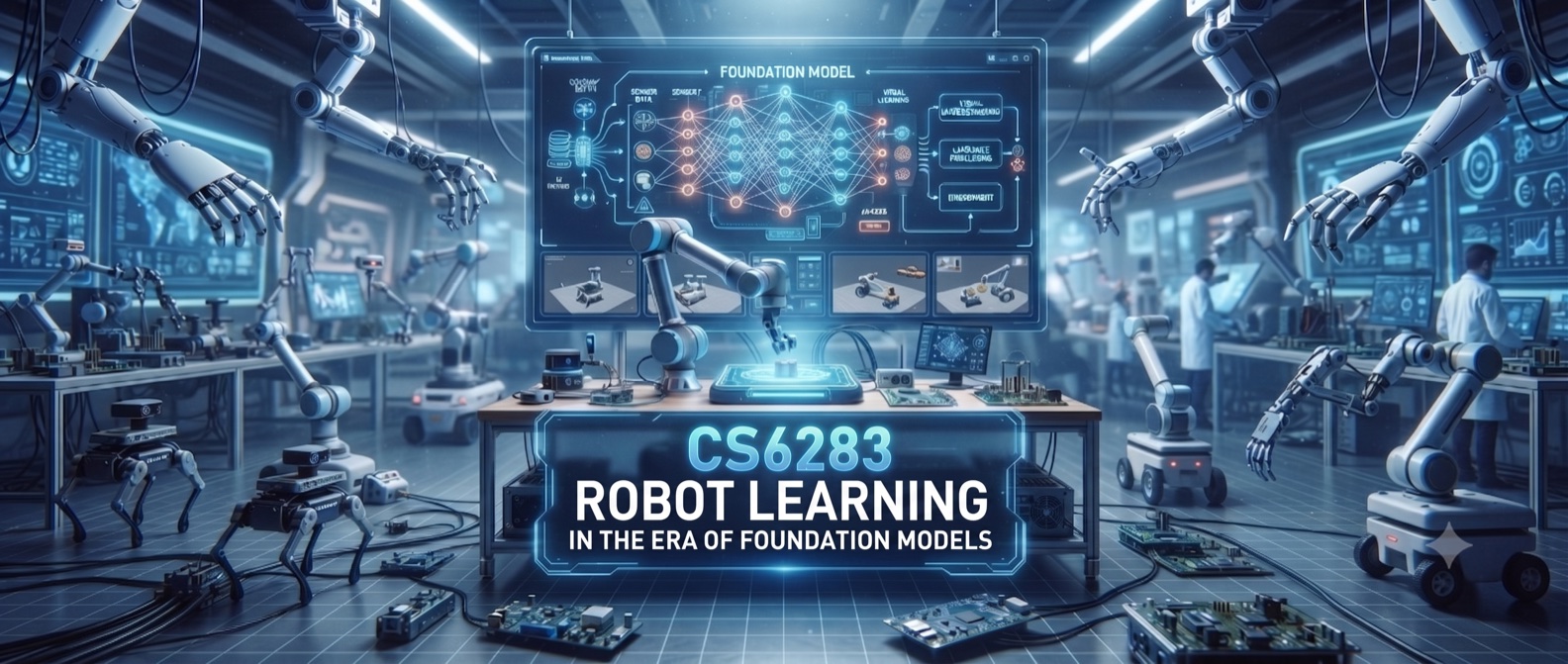
This advanced course explores modern machine-learning algorithms for autonomous robots as embodied intelligent agents, examining how embodied AI differs from internet AI in perceiving raw sensory data, making decisions, and adapting to the physical world. It bridges classical techniques with recent advances in large-scale models, starting from the fundamentals of robotic manipulation, imitation learning, reinforcement learning, and policy optimization, and progressing to Vision-Language-Action (VLA) models and foundation models for robotics. Through debating cutting-edge papers and completing a hands-on project, students will learn to formulate problems, design algorithms, validate ideas experimentally, and engage with the research process.
Class meets Mondays. Topics are tentative and subject to change.
| Week | Date | Topic |
|---|---|---|
| 1 | Mon, Aug 10, 2026 | Course overview & introduction to embodied AI |
| 2 | Mon, Aug 17, 2026 | Robotic manipulation foundations I — rigid-body kinematics & contact mechanics |
| 3 | Mon, Aug 24, 2026 | Robotic manipulation foundations II — grasping & motion planning |
| 4 | Mon, Aug 31, 2026 | Imitation learning I — behavior cloning & DAgger |
| 5 | Mon, Sep 7, 2026 | Imitation learning II — Action Chunking Transformers (ACT) & Diffusion Policy |
| 6 | Mon, Sep 14, 2026 | Reinforcement learning I — MDPs & value-based methods |
| — | Sep 19 – Sep 27, 2026 | Recess / reading & examination period — no class |
| 7 | Mon, Sep 28, 2026 | Reinforcement learning II — policy-gradient methods, PPO & SAC |
| 8 | Mon, Oct 5, 2026 | Reinforcement learning III — offline RL & sim-to-real transfer |
| 9 | Mon, Oct 12, 2026 | Vision-Language-Action models I — RT-1, RT-2, OpenVLA |
| 10 | Mon, Oct 19, 2026 | Vision-Language-Action models II — MolmoAct, π-0.5, cross-embodiment learning |
| 11 | Mon, Oct 26, 2026 | Long-horizon reasoning — SayCan, Manipulate-Anything, Code-as-Policies |
| 12 | Mon, Nov 2, 2026 | Foundation models for robotics — world models & generative simulators |
| 13 | Mon, Nov 9, 2026 | Course wrap-up & project work session |
| 14 | Nov 14 – Nov 20, 2026 | Reading week — no class |
| — | Mon, Nov 23, 2026 | Final project presentations |
Students complete a quarter-long capstone project in teams of two to three, applying course concepts to an open problem in robot learning — e.g. imitation or reinforcement learning for manipulation, adapting a Vision-Language-Action model to a new task or embodiment, or evaluating a foundation model's capability as a robot policy or world model. Projects may be validated in simulation or on physical hardware where available.
| Milestone | Deliverable |
|---|---|
| Proposal | 1-page problem statement, related work, and planned approach |
| Check-in | Progress update & preliminary results |
| Final | Presentation and written report |
Most weeks include reading requirements featuring news articles and academic conference papers selected to illustrate key course concepts for class discussion. Students must write commentaries describing their takeaways from papers, due 48 hours before the discussion section.
All submissions go to Canvas.
The purpose is to encourage critical thinking about research importance, not summarization. Appropriate topics include:
A recommended structure uses two positive points and one criticism per paper (approximately 4 sentences each).
Deadline: Canvas submission at 1:30pm, two days before the discussion session. Late submissions are not accepted. After submission, commentaries become available to discussion leaders.
Grading Scale: Check-minus/Check/Check-plus
Format adapted from Colin Raffel's role-playing seminar and the CSE 599H commentaries page.
Seminar Roles & Responsibilities
One hands-on in-class assignment accompanies the course, implementing and evaluating a policy-learning baseline (e.g. behavior cloning or a diffusion policy) on a manipulation benchmark. Submissions are graded on correctness, code quality, and a brief write-up of results. Due date TBD.
| Component | Weight |
|---|---|
| Class Participation | 30% |
| Project Proposal (Group) | 20% |
| Final Project Proposal (Group) | 25% |
| Project Report (Individual) | 15% |
| In-Class Assignment | 10% |
Live 3D simulation of a robotic arm picking and placing cubes — drag to orbit, scroll to zoom.
Blue-tinted zone: pick tray · orange-tinted zone: place tray. The arm solves inverse kinematics live for every move.
Core papers and texts for each unit. Updated as the syllabus firms up.